
Comparing the 5-year cost of at-home vs. salon laser hair removal

Laser hair removal can involve more than the price of an initial treatment. For consumers comparing professional clinic appointments with at-home hair removal devices, the long-term cost depends on treatment frequency, maintenance needs, the areas being treated and the suitability of each technology.
At-home devices offer convenience and the potential to reduce recurring provider fees. Professional treatments, meanwhile, give consumers access to trained practitioners and equipment selected for their individual needs.
This analysis by DermRays provides insight for consumers on the total cost of ownership alongside treatment expectations, device specifications and safety considerations.
What Does Professional Laser Hair Removal Cost?
Professional laser hair removal generally requires multiple sessions, because hair grows in cycles and not all follicles respond equally to treatment at the same time.
The American Academy of Dermatology (AAD) notes that patients often need six or more treatments. Results can last for months or years, but some hair may regrow and require additional treatment.
The total cost varies by location, provider, treatment area and number of appointments. Consumers should request a quote covering the complete treatment plan rather than compare individual session prices alone.
Additional costs may include:
- Initial treatment course: The combined cost of the sessions recommended by the provider.
- Maintenance appointments: Additional treatments may be needed if hair regrows.
- Travel and scheduling: Repeated visits can involve transportation expenses and time away from work or other activities.
- Multiple treatment areas: Treating the legs, underarms, bikini area and other zones may require different pricing or packages.
These expenses can accumulate over several years, particularly for consumers treating multiple areas.
Is At-Home Laser Hair Removal More Cost-Effective?
At-home hair removal devices shift more of the expense to the initial purchase. Instead of paying a provider for each appointment, consumers purchase a device and follow its recommended treatment schedule at home.
The potential savings depend on the purchase price, device lifespan, maintenance requirements and whether the device is appropriate for the user's hair and skin characteristics.
Consumers should also distinguish between IPL and diode laser devices. IPL uses broad-spectrum pulsed light, while a diode laser emits light within a narrower wavelength range. These technologies differ, but the technology label alone does not establish a device's treatment effectiveness or safety.
The AAD recommends consulting a dermatologist before using an at-home laser device because these products are not suitable for everyone.
A Five-Year Cost Model: How to Compare the Options
A useful cost comparison should make its assumptions explicit. Because treatment prices and maintenance schedules vary, the following example is a calculation rather than a claim about average national spending. Professional laser hair removal sessions typically range from $150 to $400+ depending on the treatment area and provider, while advanced at-home laser devices generally retail between $400 and $700. In this model, $250 per session and $499 for the at-home device are used as a representative scenario to illustrate how consumers can compare long-term costs.
Consider a consumer comparing eight professional appointments with an at-home device.
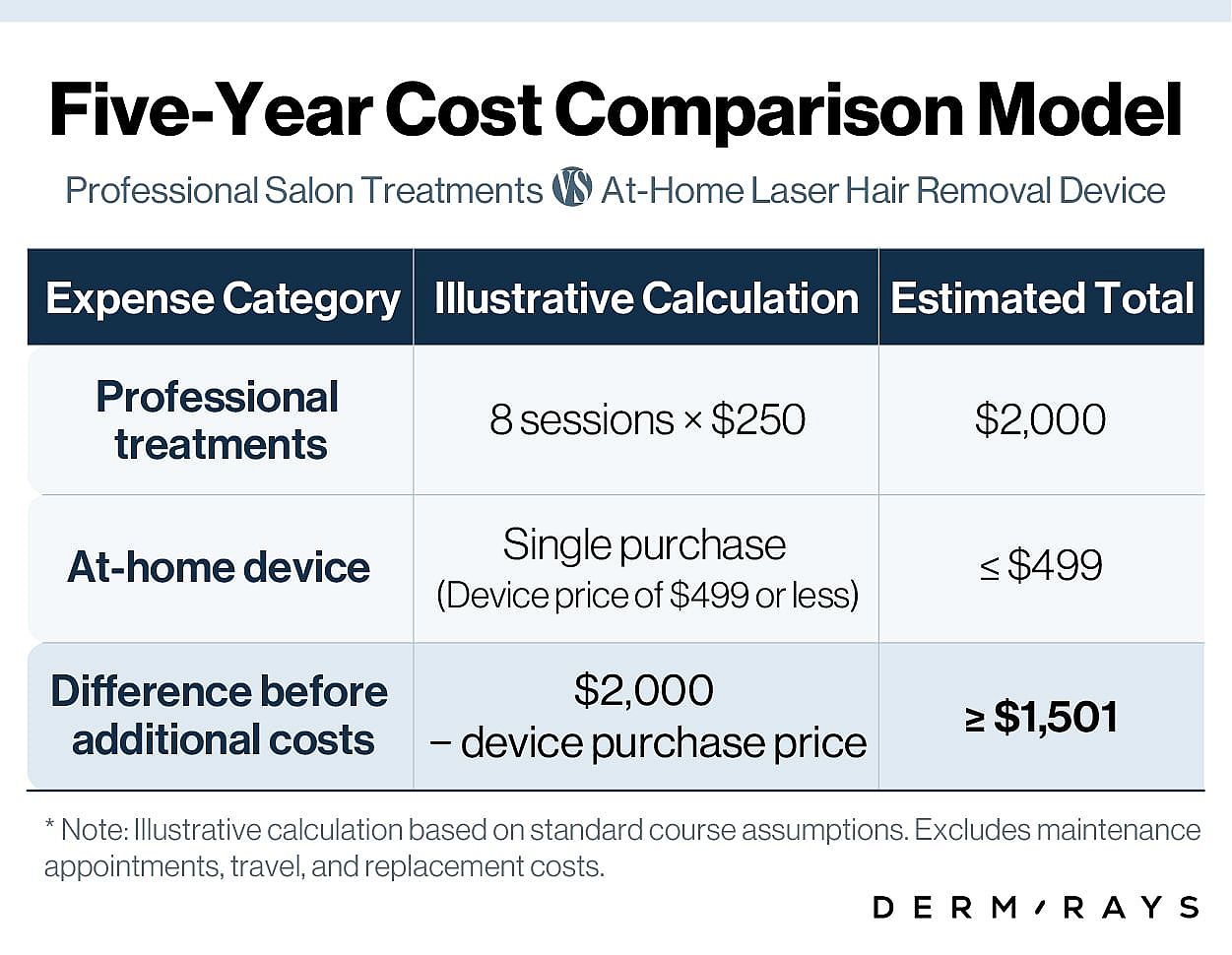
For a more complete five-year comparison, consumers can use the following formula:
- Professional treatment cost
Total session fees, plus maintenance appointments and travel expenses. - At-home ownership cost
Device purchase price, plus replacement parts or other ownership costs.
The break-even point can then be estimated by dividing the at-home device's total cost by the cost of a professional appointment. However, this is a financial comparison only. The result is meaningful when both options are suitable for the consumer and the comparison accounts for their different treatment requirements.
What Should Consumers Compare When Choosing an At-Home Diode Laser?
The purchase price is only one part of a device's value. Consumers comparing at-home diode laser hair removal systems should examine the technical specifications, intended use and manufacturer instructions.
Key considerations include:
- Wavelength. A diode laser's specified wavelength helps describe its optical characteristics. However, wavelength alone does not determine treatment performance.
- Energy output. Consumers should look for documented energy specifications and understand how the manufacturer defines and measures them.
- Cooling technology. Cooling systems may improve treatment comfort and help manage surface heat, but they do not eliminate the risk of burns or other adverse effects.
- Treatment capacity. Advertised pulse counts can help consumers understand the intended service life of a device. Actual longevity depends on device design, use and maintenance.
- Skin and hair compatibility. Consumers should confirm whether a device is appropriate for their skin tone, hair color and intended treatment areas.
- Safety and regulatory information. Check the exact model's applicable clearances or authorizations, contraindications and treatment instructions. Regulatory status should not be inferred from a wavelength or technical specification.
These factors provide a more meaningful basis for comparison than marketing terms such as "professional-grade" alone.
Can FSA or HSA Funds Cover At-Home Hair Removal Devices?
Flexible Spending Accounts (FSAs) and Health Savings Accounts (HSAs) offer tax advantages for eligible medical expenses, but consumers should not assume that cosmetic hair removal qualifies.
The IRS generally excludes expenses for procedures performed primarily to improve appearance rather than to treat a disease or correct a qualifying medical condition. Its guidance specifically discusses hair removal in the context of cosmetic expenses.
A letter of medical necessity does not automatically make a particular device or purchase eligible. Consumers should confirm the expense's eligibility with their benefits administrator and healthcare provider before using FSA or HSA funds.
Consequently, potential tax savings should not be included in a cost comparison unless the consumer's specific purchase qualifies under the applicable rules.
Which Option Offers Better Long-Term Value?
Neither professional laser hair removal nor an at-home device is automatically the better choice for every consumer.
Professional treatment may be preferable for people who need an individualized assessment, want treatment administered by a qualified practitioner or have skin and hair characteristics requiring specialized care.
An at-home device may be worth considering for consumers who prefer home use, plan to treat multiple compatible areas and want to avoid repeated provider fees. Its financial value depends on suitability, service life and the results it can reasonably deliver.
The most useful five-year comparison considers not only the initial price but also treatment needs, maintenance, safety and expected product lifespan. A transparent calculation can help consumers identify the option that offers the best value for their circumstances.
This story was produced by DermRays and reviewed and distributed by Stacker.


Comments
